
Home / Mountain Crisis Services / Teen Dating Abuse
Mountain Crisis Services · Get informed
Teen dating abuse
Teen dating violence is similar to and can be as lethal as adult relationship violence. About one in ten teen couples is affected by dating violence, and very few tell anyone who could help. Talking to us is free and confidential.
Questions to ask in identifying abusive behavior
Ask yourself honestly:
- Are you unable to disagree with your partner?
- Does your partner put you down, but then tell you they love you?
- Have you been held down, shoved, pushed, hit, kicked, or had things thrown at you by your partner?
- Does your partner make you choose between them or family and friends?
- Does your partner get jealous when you go out or talk with others, or constantly check up on you?
- Has your partner forced or intimidated you into having sex?
- Are you afraid to break up with your partner because you fear for your personal safety?
- Are you constantly apologizing for your partner's behavior, or feeling like you have to justify everything to your partner?
If you answered yes to one or more of these questions, the relationship may be abusive. Part of ending the violence is breaking the silence about the abuse. You can find a way out.
Who you can talk to
- Call our 24-hour line — 1‑888‑966‑2350 in Mariposa County, or Valley Crisis Center at (209) 722‑4357 in Merced County. It's confidential.
- A trusted adult: your parents, a teacher, a counselor, a parent of one of your friends, a coach, or your employer.
- Nationally: love is respect — call 1‑866‑331‑9474 or text LOVEIS to 22522.
Things to do when ending an abusive relationship
- Keep a dated record of the abuse.
- Do not meet your partner alone, or let them into your house or car while you are alone.
- Avoid being alone at school, at work, and on your way to and from places.
- Vary the routes and times you travel to and from home, school or work.
- Tell someone where you are going and when you plan to be back.
- Plan and rehearse what you would do if your partner confronted you or became abusive: have a safety plan!
How to help a friend who may be in an abusive relationship
- Talk to your friend and be non-judgmental when talking about the abuse.
- Listen to your friend and believe him/her.
- Let them know that violence under any circumstance is not okay.
- Point out your friend's strengths. They may not be able to see their abilities because of the abuse.
- Encourage your friend to talk with a trusted adult and offer to go with them for help.
- Talk to a trusted adult if you feel your friend's situation is getting worse.
- Call the police if you witness an assault.
Things NOT to say or do
- Don't be critical of your friend and her/his partner.
- Don't ask blaming questions like "what did you do to provoke him?" or "why can't you handle him?"
- Don't assume you know what is best for your friend.
- Don't give your friend an ultimatum: your friendship or their partner. They need your support regardless of their decision.
- Never put yourself in danger by being a mediator.
Things you can do to create change
- Start a peer education group about violence in relationships.
- Make posters or hold events during Teen Dating Violence Awareness Month in February.
- Produce plays in your Drama Program that address dating violence or domestic violence.
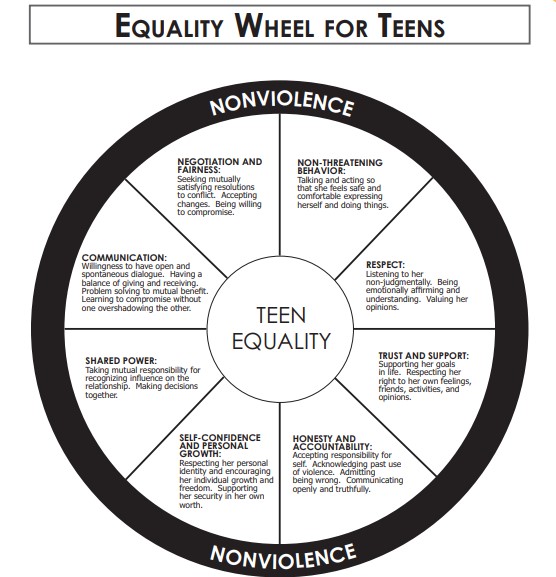
- Make a commitment to support non-violence in your words, actions and relationships.
Types of abuse
What is emotional abuse/verbal abuse?
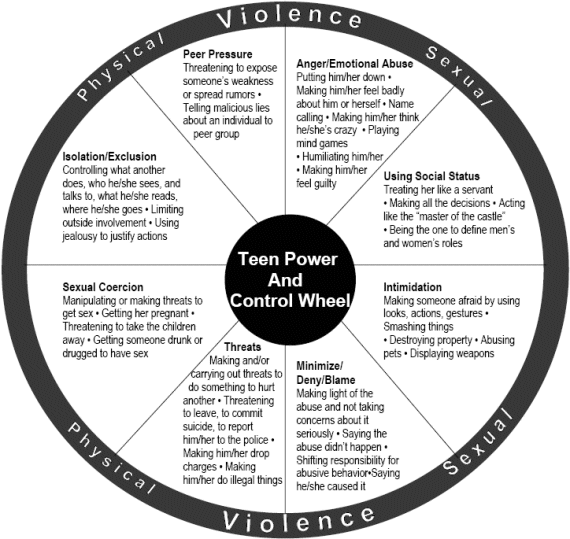
Non-physical behaviors such as threats, insults, constant monitoring or "checking in," excessive texting, humiliation, intimidation or isolation.
What is stalking?
Being repeatedly watched, followed or harassed.
What is financial abuse?
Using money or access to accounts to exert power and control over a partner.
What is physical abuse?
Any intentional use of physical force with the intent to cause fear or injury, like hitting, shoving, biting, strangling, kicking or using a weapon.
What is sexual abuse?
Any action that impacts a person's ability to control their sexual activity or the circumstances in which sexual activity occurs, including restricting access to birth control or condoms.
What is digital abuse?
The use of technology such as texting and social networking to bully, harass, stalk or intimidate a partner. Often this behavior is a form of verbal or emotional abuse perpetrated through technology.
For more information on teen dating violence, check out the Parents' Guide to Teen Dating Violence from the Center for Relationship Abuse Awareness & Action — it has great resources to pinpoint abusive teen relationships and identify a teen abuser.
A guide for parents
Very few teens tell anyone who could help, so watch for warning signs: withdrawing from school activities; becoming secretive, ashamed, or isolated from family and friends because of the relationship; a partner who calls several times a night or shows up unexpectedly to "check up"; apologizing for a partner's behavior; and physical bruises, signs of injury, or damaged personal property.
The use of alcohol or other drugs could be a teen's response to pressure from his/her partner. It may also be an attempt to numb pain or emotions. However, substance abuse is no excuse for or escape from violent behavior. If the alcohol or other drugs were taken away, the underlying causes and the violence in the relationship may still not be resolved.
- Make sure the timing is right. Talk about the abuse when you are sharing time together, and have specific examples ready to share. Use "I" statements to describe your feelings, and let your teen know how concerned you are about their safety and well-being.
- Listen and believe your teen. Speak with sensitivity, support, and care. If your teen opens up, you may hear uncomfortable details; stay nonjudgmental and focus on resolving the problem rather than criticizing your teen or their partner.
- Let your teen have some control in making decisions. Their self-esteem and confidence may have been lowered by the abusive partner, so don't pressure them into quick decisions. Don't assume the victim wants to leave the relationship — help them assess the situation.
- Help your teen create a safety plan for when they are at school and out with friends, and be a role model for supportive, healthy relationships with your own partner.
Where to go for information and help: National Domestic Violence Hotline — 1‑800‑799‑7233.
Source: California Attorney General's Office
Our advocates can talk with parents too, including about procedures for obtaining restraining or stay-away orders. Call (209) 742‑5865.
Prevention education
Mountain Crisis Services offers teen dating abuse education and violence-prevention programs for local schools and youth groups. To request a presentation, call our office at (209) 742‑5865.