
Home / Mountain Crisis Services / Domestic Violence
Mountain Crisis Services · Get informed
Understanding domestic violence
Domestic violence is a pattern of emotionally, physically, or sexually abusive behavior that one person uses in a relationship to control another person. It can occur in families and friendships, and the manipulation is often very subtle. The abuse is not the victim's fault, and help is available.
Warning signs
Are you a victim of domestic violence? Ask yourself these questions:
- Are you frightened by your partner's temper? Are you afraid to disagree?
- Are you constantly apologizing for your partner's behavior, especially when they have treated you badly?
- Do you have to justify everything you do, every place you go, or every person you see just to avoid your partner's anger?
- Does your partner put you down, then tell you that they love you?
- Have you ever been hit, kicked, shoved, or had things thrown at you?
- Do you not see family or friends because of your partner's jealousy?
- Have you been forced into having sex when you didn't want to?
- Are you afraid to break up because your partner has threatened to hurt you or themselves?
- Does your partner control all the money?
- Does your partner deny your basic needs such as food, housing, clothing, or medical and physical assistance?
- Does your partner break things when angry, or steal or destroy your belongings?
- Does your partner threaten to hurt you or others, to have you deported, or to disclose personal information about you?
- Has your partner ever threatened to kill you?
- Has your partner used a weapon or object against you, or threatened to?
If you answered yes to some of these questions, there is help, and you are not alone. You can call us just to talk it through.
Make a safety plan
No one deserves to be abused. If things get out of hand, it's good to have a plan. If you are in an abusive relationship, here are some ideas to help you become safe and to stay safe. Remember, you cannot stop your partner's abuse, but you can find help and support for yourself. An advocate can build a plan with you on the phone, or you can start here:
Be prepared to get away
- Set aside keys to the house and car.
- Gather important papers: birth certificates, Social Security cards, marriage and driver's licenses.
- Keep credit cards, bank account numbers, and ATM cards accessible.
- Set aside medications for yourself and your children.
- Pack spare clothes and a list of important phone numbers and addresses.
- Put some money away. Even if you only save a little bit every week, you need to have some money of your own.
- Make copies of keys and papers and leave them with a friend, neighbor, or church.
Plan your escape
- If you need to flee, know the escape routes in advance. Decide on a door or window you can exit quickly and safely.
- Plan with your children: identify a safe place for them — a room with a lock, or a neighbor's house. Reassure them that their job is to stay safe, not protect you.
- During an argument, move away from the kitchen, bathroom, or anywhere with dangerous objects.
Ways to stay safe on your own
- Change the locks on your doors, and learn about your legal rights.
- Keep a safety plan for coming and going, and share it with people you trust.
- Contact the 24-hour confidential crisis line — in Mariposa County: (209) 966‑2350 or toll-free 1‑888‑966‑2350; in Merced County: (209) 722‑4357.
Also see our internet & browsing safety guide — technology can reveal your plans.
Read more: the full safety plan, including what to do when a fight breaks out and your rights
Myths & facts
Myth: The issue of domestic violence or intimate relationship abuse affects only a small part of the population.
According to the CDC, intimate partner violence affects millions of people in the United States. More than 1 in 3 women — nearly 43.5 million — have experienced contact sexual violence, physical violence, and/or stalking by an intimate partner during their lifetimes. About 1 in 5 women have experienced contact sexual violence, nearly 1 in 4 have experienced physical violence, and about 1 in 8 have experienced stalking by an intimate partner. Intimate partner violence can also be fatal: CDC data indicate that more than half of female homicide victims are killed by a current or former male intimate partner.
Myth: Domestic violence only happens to poor, uneducated and minority women.
Abuse happens to women from all types of families, all income levels, all ethnicities, all professions, all religions, and all education levels. It happens in towns, suburbs, inner cities, neighborhoods and rural areas. Abused women with few financial or personal resources are more visible because they are more likely to seek help from public organizations. Women from middle and upper economic groups are more likely to seek help from private organizations or individuals.
Myth: Alcohol causes the abuse.
Although alcohol can cause violence to increase in severity, violent men will hit when they are drunk or sober. Abusers will use alcohol as an excuse for violent behavior and as a way to avoid taking responsibility for their actions. Stopping an abuser's drinking will not make the violence stop. They are separate problems that often overlap.
Myth: Women deserve to get hit, and men have the right to discipline their partners.
Every relationship has arguments and stress, but most men do not hit people when they get angry. Most victims are abused for no reason, over little things or even in their sleep. While our society comes from a patriarchal system that used to give men the legal right to abuse their wives and children, our society no longer supports this idea. Women and children are not the property of men, and domestic violence is a crime in every state.
Myth: When there is violence in the home, all members of the family are participating, and all of them have to change for the violence to stop.
Only the abuser has the ability to stop the violence. Harming another person is a choice that the abuser must be held responsible for. Many abused women try to change their behavior in the hope that this will stop the violence. This does not work. Changes in family members' behavior will not cause the abuser to be non-violent.
The abuse is not the victim's fault!
Consider these statistics
Domestic violence is about one person using their power to control another person. Every 9 seconds a woman is assaulted…
- More women are injured by domestic violence than are injured in auto accidents, muggings or rapes, combined.
- 1 in 3 women and 1 in 4 men have experienced rape, physical violence, and/or stalking by an intimate partner in their lifetime.
- An average of 24 people per minute are victims of rape, physical violence or stalking by an intimate partner in the United States — more than 12 million women and men over the course of a single year.
- 80% of women with children who are experiencing homelessness were previously victims of domestic violence.
- Approximately 1 in 5 women and 1 in 7 men who experienced rape, physical violence, and/or stalking by an intimate partner first experienced some form of partner violence between 11 and 17 years of age.
- 36% of high school relationships involve some type of violence.
- One in five teenage girls and one in ten boys report to have suffered physical and/or sexual violence at the hands of a dating partner.
- 75–85% of domestic violence victims are women.
- Historically, females have been most often victimized by someone they knew.
- Women ages 18 to 24 and 25 to 34 generally experience the highest rates of intimate partner violence.
- 1 in 5 homicide victims are killed by an intimate partner. The reports also found that over half of female homicide victims are killed by a current or former male intimate partner.
- Less than one-fifth of victims reporting an injury from intimate partner violence sought medical treatment following the injury.
- Many other negative health outcomes are associated with intimate partner violence. These include conditions affecting the heart, muscles and bones, and digestive, reproductive, and nervous systems, many of which are chronic.
- Survivors can experience mental health problems such as depression and post-traumatic stress disorder symptoms. They are at higher risk for engaging in behaviors such as smoking, binge drinking, and risky sexual activity. People from some racial and ethnic minority groups are at higher risk for worse consequences.
- The lifetime economic cost of IPV-related medical care, lost productivity from paid work, and criminal justice costs is $5.6 trillion. The cost of IPV over a victim’s lifetime is nearly $135,000 for women and over $30,000 for men.
Read more: domestic violence FAQs — why victims stay, whether abusers can change, and how to help
Lesbian, gay, bisexual, transgender, and queer abuse
LGBTQIA2+ people experience domestic abuse at the same rate as heterosexual women.
Domestic violence — it's something that can affect anyone. Lesbian, gay, bisexual, transgender and queer (LGBTQ) people do experience domestic abuse, but the reality of LGBTQ relationship violence is rarely discussed. LGBTQ people can be reluctant to seek help from the police for fear of homophobic or transphobic treatment, and may be unable to turn to family or friends for support if they are not 'out' about their sexuality. This can leave LGBTQ people who suffer from domestic violence especially isolated and at risk of further abuse.
About 25% of LGBTQ people suffer through violent or threatening relationships with partners or ex-partners — about the same rate as heterosexual women. Sometimes the abuse looks similar to that experienced by heterosexual women: emotional bullying, physical aggression, threats to harm the victim or other loved ones, social isolation, control of finances, extreme jealousy. There are additional features that can be present in LGBTQ intimate partner violence that do not factor into heterosexual relationships. The abuser may threaten to 'out' the victim to friends, family, religious communities, co-workers, and others if he or she does not comply with the abuser's wishes. The abuser may use the close-knit dynamic of the gay and lesbian community and the lack of support for LGBTQ people outside the community to further pressure the victim into compliance.
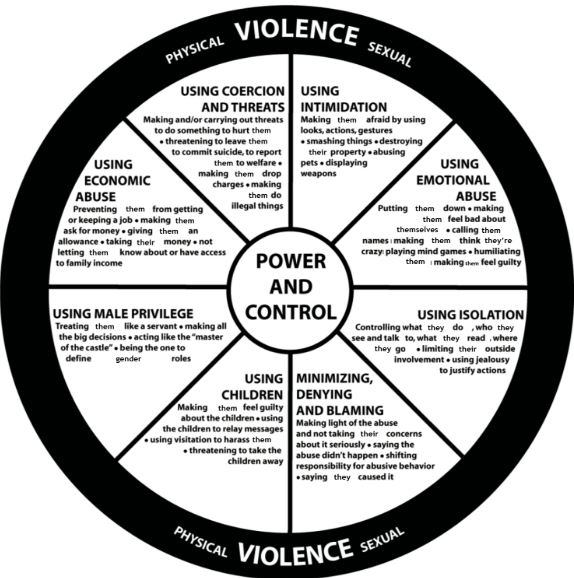
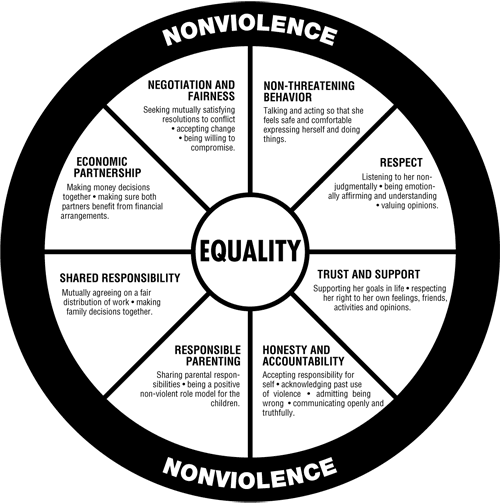
The Power and Control Wheel and the Equality Wheel
Advocates often use the Power and Control Wheel to describe how abusive behaviors such as intimidation, isolation, economic abuse, using children, and threats work together. Its counterpart, the Equality Wheel, represents what a healthy relationship should include: respect, trust and support, honesty, shared responsibility, economic partnership, and non-threatening behavior. If you would like to walk through either one, call us — the conversation is free and confidential.
More resources
- National Domestic Violence Hotline — 1‑800‑799‑7233 (TTY 1‑800‑787‑3224), or text START to 88788
- California Partnership to End Domestic Violence
- National Network to End Domestic Violence — safety tips and resources
- WomensLaw — legal information and resources for victims
- Valley Crisis Center — our sister agency serving Merced County
- Teen dating abuse — for teens and parents